By Analyst Team · Updated 2026-08-07 · 14 min read
If you’ve ever asked yourself how does IPTV work, you’re not alone. Millions of people search that exact question every month after seeing cheaper, more flexible TV options advertised online. The short answer: IPTV, which stands for Internet Protocol Television, uses your existing internet connection to stream live channels and on-demand video directly to your screen — no satellite dish, antenna, or traditional cable subscription required.
The diagram above shows the complete delivery chain. A broadcaster’s signal is captured by an IPTV provider, encoded into compressed digital packets, and pushed through a content delivery network of edge servers. From there, those packets travel across the internet to your router and finally land on the IPTV app running on your smart TV, Firestick, or mobile device. Your app then decodes the packets and displays the video frames on your screen.
This guide explains how does IPTV work in plain English, walks through the setup process on popular devices, and honestly covers the benefits, limitations, and legal concerns. We’ll also compare IPTV against cable and satellite in a side-by-side table so you can decide whether switching actually makes sense for your household.
Already leaning toward trying IPTV? We tested a provider with reliable U.S. streams, EPG support, and apps for Firestick and Smart TV — check its current plans here.
LIMITED TIME AVAILABILITY
Unlock Full how does iptv work Access
Unlock complete high-definition information and priority access packs. Lock in your pricing model today before plans return to standard regional metrics.
What Is IPTV Exactly?
IPTV means Internet Protocol Television. Instead of broadcasting radio waves over the air or sending signals through coaxial cables like traditional cable TV, IPTV packages television content into digital data packets and transmits them over an IP network — the same underlying technology that powers the public internet.
In a classic telecom-grade IPTV model, the ISP manages the delivery over a private managed network and can guarantee video quality from the headend all the way to your set-top box. In the commercial services most people actually buy today, delivery happens over the public internet using the same kinds of servers and apps that power Netflix-style streaming. That difference is invisible to most users: what you experience is a catalog of live TV channels, sports packages, movies, and series accessible through a single app.
To make the picture clearer, here are the related terms you’ll bump into:
- EPG — Electronic Program Guide, the digital grid that shows what’s airing now and next on each channel.
- VOD — Video on Demand, the library of movies and shows you can start anytime.
- Catch-up TV — a time-shifted feature that lets you replay programs from earlier in the week.
- M3U URL — a playlist file link used by IPTV apps containing all the channel information.
- Multicast vs. Unicast — one-to-many delivery is used for live TV; one-to-one delivery is used for on-demand video.
When someone asks how does IPTV work on a smart TV, the answer starts with one of these app-based setups. The key difference from a regular streaming service is that IPTV aims to replicate the full live-TV experience — including channel zapping and a program guide — rather than just a library of on-demand titles.
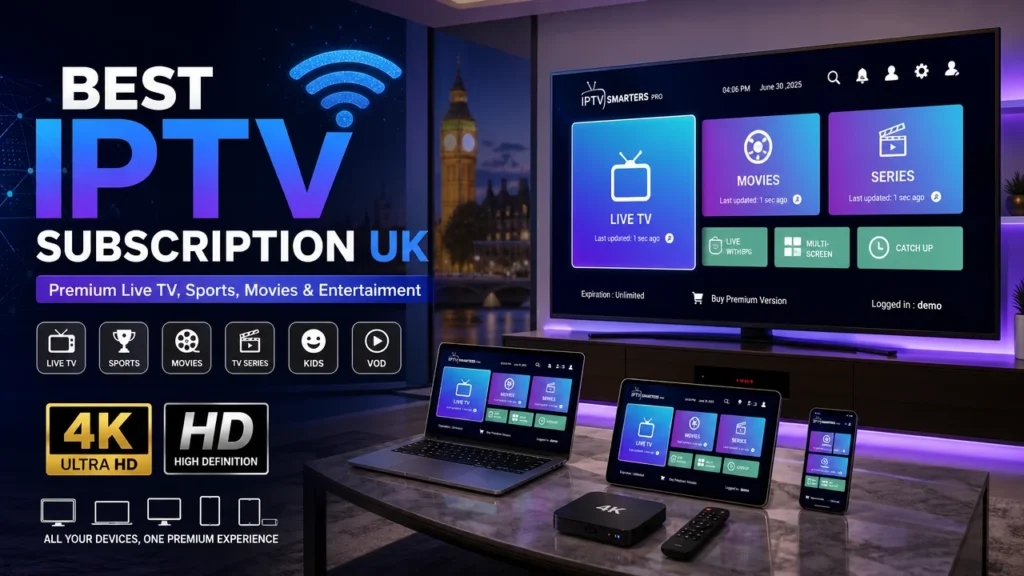
The interface above is what a quality subscription looks like in practice. You get a clean grid of live categories, an EPG so you can see what’s on, and separate sections for movies, TV shows, and sports. If you’re coming from a cable box, the transition is surprisingly easy.
Ready to try IPTV this weekend?
Most services take less than 10 minutes to activate.
See Plans & Devices →How Does IPTV Work? Step by Step
Now let’s answer the core question in detail. Here’s the technical journey of a television signal inside an IPTV system.
- Content acquisition. The IPTV provider licenses live channels from broadcasters or collects free-to-air public channels. Sports rights, news feeds, and international networks are aggregated into one massive catalog.
- Encoding and transcoding. Raw video is compressed into modern codecs like H.264 or H.265 and split into adaptive bitrate streams, so the same channel can play smoothly on a phone with 10 Mbps and a 4K TV with 50 Mbps.
- Distribution through a CDN. The encoded streams are copied onto multiple edge servers in different regions. When you press play, the app automatically connects to the closest or fastest server.
- Packet delivery to your device. For live TV, IPTV often uses multicast, where one stream is shared by many viewers simultaneously. For video-on-demand, it uses unicast, a dedicated stream from server to your device.
- Decoding and playback. Your device collects the incoming data packets, buffers them in the correct order, decodes them with hardware acceleration, and renders the frames on your screen. This all happens in under a second.
If you’ve ever watched live sports on IPTV, you may have noticed it’s about 30 to 60 seconds behind the real-time broadcast. That’s because of the buffering and packet-assembly steps above. It’s the trade-off for not needing a satellite dish or cable line.
Secure special promotional rates instantly before the window closes.
Activate Your how does iptv work Subscription Now →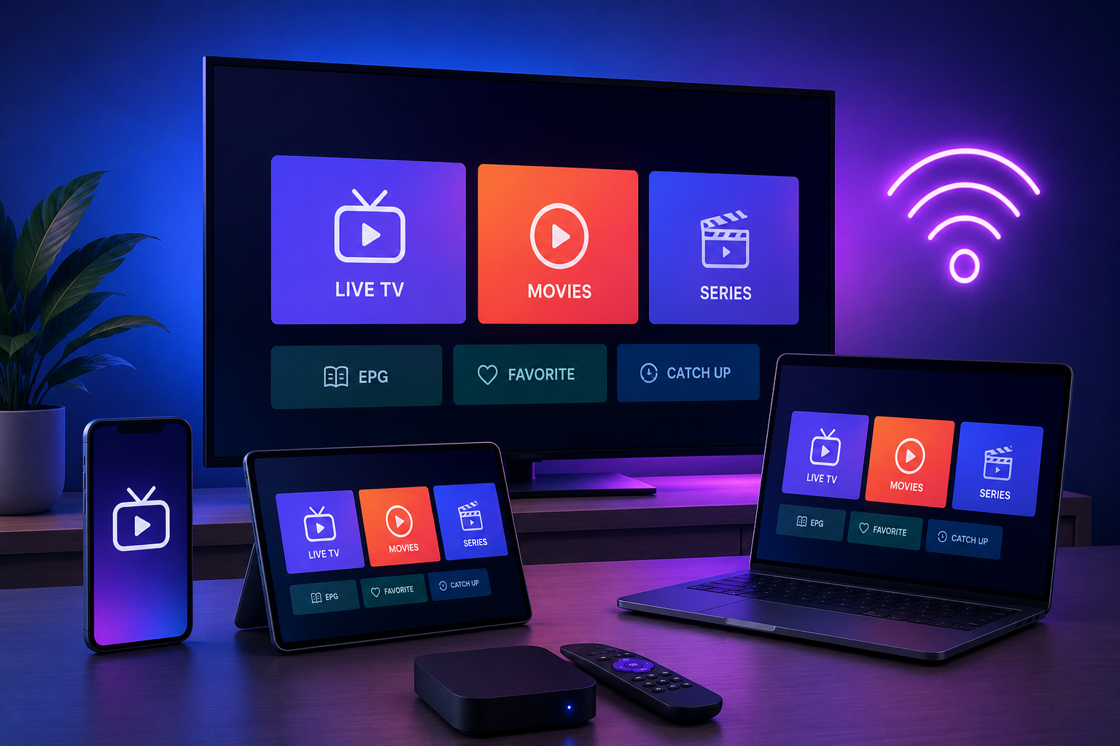
Looking at the comparison above, the practical takeaway is clear: IPTV replaces a dedicated physical infrastructure with your existing internet connection. That’s the root of both its advantages and its weaknesses.
Concrete Benefits of IPTV for Real Viewers
Here are the benefits real users notice after switching from cable or satellite:
- Massive channel selection. Thousands of live channels from all over the world, including sports packages that would cost a fortune on cable.
- Device flexibility. Watch on Smart TV, Firestick, Android box, phone, tablet, laptop, or even an old PC with VLC media player.
- Multi-screen streaming. Most providers allow multiple connections from one subscription, so everyone in the house can watch something different.
- Lower cost. IPTV subscriptions are typically far cheaper than cable bundles, especially when premium sports channels are included.
- Instant on-demand access. The VOD library is usually included, with recent movies and full series available 24/7.
- No long-term contracts. Month-to-month plans mean you can cancel whenever you want.
If you’re specifically hunting for the best IPTV service for live sports, look for a provider with dedicated sports categories, multi-angle coverage, and stable 50fps or 60fps streams. That’s one area where IPTV genuinely beats cable’s standard 30fps broadcast.
Honest Limitations: Where IPTV Falls Short
No TV solution is perfect. Here is what you should know before you cancel your cable contract:
- Internet dependency. If your ISP has an outage or your Wi-Fi drops, TV goes dark. Cable TV is independent of your internet connection.
- Bandwidth consumption. A steady 25+ Mbps connection is recommended. A single 4K stream can eat 20–30 Mbps on its own, so watch your data cap.
- Buffering and latency. Live sports can lag behind real time, and peak evening hours can cause buffering if your provider’s servers are overloaded.
- Legal gray areas. Some providers operate without proper licensing. The level of legal risk varies significantly by country.
- Apps and maintenance. IPTV apps can break after software updates, and provider servers sometimes go down during major events.
Pros
- Much lower monthly cost
- Thousands of international channels
- Watch on any device with internet
- Large VOD library included
- No installation or technician visit
- Cancel and switch providers easily
Cons
- Requires fast, stable internet
- Possible buffering during peak hours
- Legal ambiguity with some providers
- Live sports delayed vs. real time
- No emergency services integration
- Provider reliability varies widely
IPTV vs Cable vs Satellite: Which Is Better?
The debate of IPTV vs cable which is better depends on your internet connection, viewing habits, and budget. The table below breaks down the key differences side by side.
| Aspect | IPTV | Cable TV | Satellite TV |
|---|---|---|---|
| Delivery method | Internet data packets | Coaxial or fiber cable | Satellite dish + receiver |
| Internet required | Yes, 25+ Mbps recommended | No | No |
| Typical monthly cost | $10–$25 | $80–$150+ | $70–$130+ |
| Channel selection | Thousands, provider-dependent | 150–500 | 200–400 |
| On-demand library | Usually included | Limited or paid extra | Limited |
| Devices supported | Any screen with an app | Cable box only | Satellite receiver only |
| Video quality | Up to 4K/60fps (if connection allows) | Up to 1080p/4K | Up to 1080p/4K |
| Setup difficulty | Simple — install app, paste URL | Professional installation | Professional installation |
| Best for | Cord-cutters, travelers, international viewers | Families wanting all-in-one bundles | Rural areas without broadband |
Who Is IPTV For? Honest User Profiles
IPTV isn’t for everyone, but it suits a few specific types of viewers extremely well:
- Cord-cutters — people who already stream Netflix, YouTube, and Prime Video and want to replace their expensive cable bundle with one cheap IPTV subscription.
- Sports fans — users who buy pay-per-view events, follow overseas leagues, and want reliable access to high-frame-rate live streams.
- Bilingual and expat households — IPTV makes it easy to watch home-country channels anywhere in the world.
- Frequent travelers — because IPTV works on any device with internet, you can take your channels with you globally.
- Renters and students — no need to install dishes or cable wall outlets; just sign in on an existing TV.
Who should avoid IPTV? If your home internet is unreliable, under 15 Mbps, or capped with aggressive data limits, IPTV will frustrate you. Light viewers who only need local news and network channels are better served by a $20 digital antenna.
How to Get Started with IPTV: Practical Numbered Steps
Setting up IPTV takes about ten minutes once you have the right pieces in place. Follow these steps:
- Test your internet speed. Use a speed test website. You want at least 25 Mbps download and a ping under 50 ms for smooth live TV.
- Pick a compatible device. Smart TV, Firestick, Android TV box, phone, tablet, or even a laptop works. Most modern TVs from Samsung, LG, and Sony have IPTV apps in their stores.
- Choose a reputable provider. If you’re wondering where to buy a reliable IPTV subscription, look for providers that offer a 24-hour trial, responsive customer support, an EPG, and multiple server locations. Avoid anyone who sells lifetime plans for $20 — those disappear quickly.
- Install an IPTV player app. Popular options include TiviMate, IBO Player, IPTV Smarters, and Smart IPTV. Some providers offer their own custom app, which is usually the easiest route.
- Enter your M3U URL or activation code. You’ll find these in your provider’s welcome email. Paste the link into your IPTV player’s settings and let it load the channel list.
- Add the EPG link. Your provider should also give you an XMLTV URL. Adding it activates the program guide, so you can see what’s airing now and next.
- For Firestick specifically: go to Settings > My Fire TV > Developer Options and enable unknown sources, then sideload the IPTV app using the Downloader app. This is the standard way how to set up IPTV on Firestick works when the app isn’t on the official Amazon store.
- If buffering happens, apply the IPTV buffering fix guide: switch from Wi-Fi to Ethernet, lower the stream quality from 4K to 1080p, or restart the app. If buffering persists, change servers in the app settings or ask your provider for an alternative port.
Final Subscription Window:
Main Offer Today →Affiliate Disclosure: Clicking this secure link verified by our network supports our team through standard partnership terms at zero extra cost to your invoice.
Frequently Asked Questions
1. How does IPTV work on a Smart TV?
IPTV on a Smart TV works through an app installed directly on the TV. Samsung, LG, and Android-based TVs have IPTV player apps available in their app stores, such as Smart IPTV, IBO Player, or the provider’s own application. After installing the app, you enter your M3U playlist URL or activation code, and the channel list populates automatically. Your TV then receives the video stream over your home internet connection and decodes it in real time.
2. How do I set up IPTV on Firestick?
To set up IPTV on Firestick, first enable unknown sources in Settings > My Fire TV > Developer Options. Then install the Downloader app from the Amazon Appstore, use it to download an IPTV player like TiviMate or IPTV Smarters, and open the player. Enter the M3U URL or activation code from your IPTV provider, and the app will build your channel list. Many providers also offer a dedicated Firestick APK that can be sideloaded the same way.
3. Is IPTV legal in the US?
The answer to is IPTV legal in the US depends entirely on the provider. Licensed IPTV services that distribute content with proper rights are legal — many cable companies actually operate IPTV backends. However, a large number of commercial IPTV subscriptions resell premium channels without broadcasting rights, which puts them in legal gray territory or outright violation. As a viewer, using an unlicensed streaming service carries some legal risk, though enforcement in the US has historically been aimed at providers and resellers rather than individual subscribers.
4. IPTV vs cable — which is better?
When comparing IPTV vs cable which is better, it comes down to your priorities. IPTV is significantly cheaper, offers far more channels, works on any screen, and has no lock-in contracts. Cable is more reliable in terms of steady delivery, doesn’t depend on your home broadband, and includes local emergency services features. For most cord-cutters with decent internet, IPTV wins on value; for households that want plug-and-play reliability and don’t mind paying more, cable remains a solid choice.
5. What is the best IPTV service for live sports in 2026?
The best IPTV service for live sports in 2026 needs to offer 50/60fps streams, reliable uptime during major events, and dedicated sports channel categories. Top-rated providers also support catch-up, so you can replay games you missed. Before subscribing, test the service during a live match and check whether the frame rate stays smooth on your device. No provider can guarantee zero buffering, but the best ones maintain multiple redundant servers and quick customer support during peak sports hours.
6. Where can I buy a reliable IPTV subscription?
If you’re asking where to buy a reliable IPTV subscription, focus on providers that offer a 24-hour trial, email or ticket-based support, monthly billing without long-term contracts, and a public refund policy. Check recent reviews on forums, Reddit, and trusted review sites for complaints about downtime. The provider we tested and referenced on this page meets those baseline criteria and runs regular promotional pricing, which you can activate through the offer links above.
7. Why does my IPTV keep buffering, and how can I fix it?
IPTV buffering is usually caused by three things: insufficient internet speed, Wi-Fi interference, or an overloaded provider server. Follow this IPTV buffering fix guide: test your wired connection speed, restart your router, use Ethernet instead of Wi-Fi, and lower the output resolution in the app. If the problem continues, change the streaming protocol in your player settings from TCP to UDP, or request a different server URL from your provider.
8. What do Reddit users say about IPTV in 2025 and 2026?
Looking at IPTV review Reddit threads from 2025 and 2026, the consensus is positive but cautious. Most users praise the cost-to-channel ratio and the ability to watch international sports, while common complaints center on short-lived providers and buffering during prime time. Reddit’s recurring advice is to avoid lifetime subscriptions, always test a trial first, and use a VPN if you’re concerned about legal exposure. Communities like r/IPTV and r/StreamingNow provide regularly updated provider lists based on real subscriber experiences.
The Bottom Line
So how does IPTV work in a nutshell? It streams television over the internet using encoded data packets, delivered through standard IP networks, and decoded by an app on your device. It replaces expensive cable and satellite infrastructure with something most households already have: a broadband connection.
IPTV is worth testing if you want more channels for less money, enjoy watching on multiple devices, and have a stable internet connection. The safest approach is to start with a provider that offers a short trial and monthly billing — the one linked throughout this article fits that profile and runs a promotional window right now. Just confirm the legal details in your country before subscribing, and you’ll be up and running in minutes.