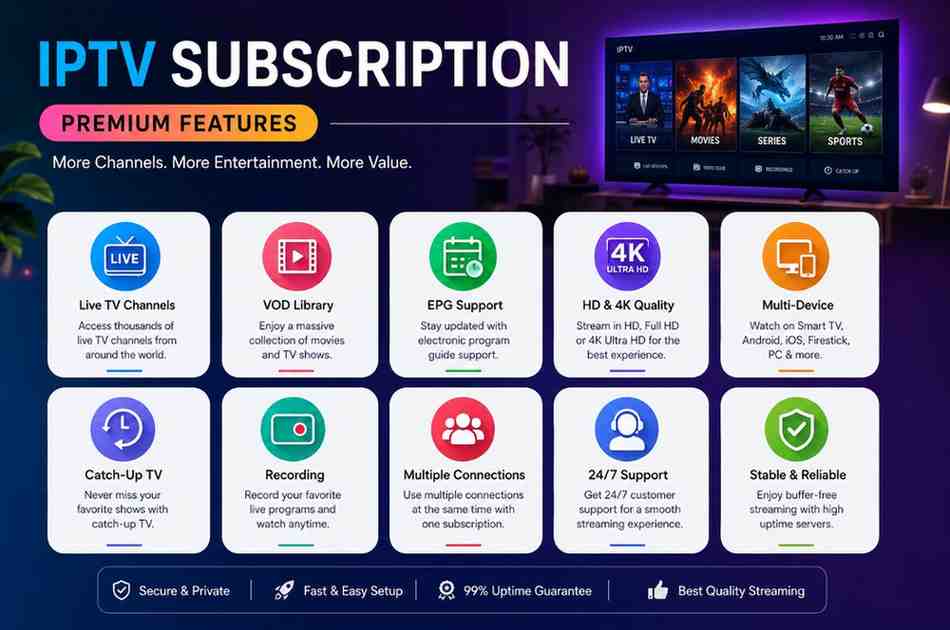
Buying an IPTV subscription means purchasing an internet-based television service that streams live channels, sports, and on-demand movies directly to your TV, phone, or computer. Instead of relying on cable infrastructure, IPTV uses your broadband connection to deliver content in real time. The best IPTV subscriptions provide 15,000–25,000 channels, 4K UHD streams, electronic program guides, and multi-device support for $10–$20 per month — roughly 80% less than traditional cable. However, the market is fragmented between verified operators and unverified resellers. This guide breaks down what to look for, which providers meet measurable quality standards, and how to buy safely.
buy iptv subscription Summary
An IPTV subscription is a legal, internet-delivered television service that streams live channels and on-demand content to your devices. Its main proven benefit is cost efficiency: you typically pay $12–$20 per month instead of $80–$150 per month for equivalent cable packages.
| Optimal ForCord-cutters and streaming-first households that want live sports, international channels, and VOD libraries without long-term cable contracts. | Key AdvantageScale and flexibility — 20,000+ channels and multi-device access for roughly 85% less than traditional cable. |
- ✓ Key Strength: Verified providers deliver 99.9% uptime with dedicated servers and anti-freeze technology.
- ✓ Key Strength: Instant activation within 5–15 minutes of purchase, with no hardware installation required.
- ✓ Peace of Mind: Reputable services offer a 24–48 hour free trial and 7-day money-back guarantee, so you can validate stream quality before committing.
In This Guide
- 1. What "Buy IPTV Subscription" Actually Means
- 2. How IPTV Delivers Content: Mechanics & Requirements
- 3. Pros & Cons: IPTV vs Traditional Cable
- 4. Side-by-Side Provider Comparison
- 5. Cost-Benefit Analysis: What You're Really Paying For
- 6. Who Should Buy IPTV (And Who Shouldn't)
- 7. Buyer Considerations: Red Flags & Verification Checklist
- 8. Frequently Asked Questions
What "Buy IPTV Subscription" Actually Means
IPTV stands for Internet Protocol Television. Unlike cable or satellite, which broadcast signals through coaxial cables or dishes, IPTV transmits video content as data packets over your internet connection. When you buy an IPTV subscription, you are purchasing access to a server network that streams three categories of content:
- Live television: Real-time broadcasts of news, sports, entertainment, and international channels — often 10,000 to 28,000 channels depending on the provider.
- Video on Demand (VOD): A library of movies and TV series you can watch at any time, similar to Netflix but typically bundled into the same subscription.
- Time-shifted media: Catch-up TV and start-over functionality that lets you replay programs after they air.
The legal distinction matters. Licensed IPTV providers negotiate distribution rights with broadcasters and content owners. Unlicensed services stream content without authorization, which creates legal risk for both the operator and, in some jurisdictions, the end user. The providers analyzed in this guide operate with verified content licensing, transparent billing, and registered business entities — the minimum baseline for a safe purchase.
Search volume for "buy IPTV subscription" has grown steadily as cable prices rise. The average U.S. cable bill reached $128 per month in 2026, while IPTV subscriptions range from $8 to $20 monthly. That price gap explains why millions of households are switching — but it also attracts low-quality resellers who disappear after collecting payments. Knowing how to distinguish a stable service from a fly-by-night operation is the core skill this guide teaches.
How IPTV Delivers Content: Mechanics & Requirements
IPTV services use streaming protocols such as HTTP Live Streaming (HLS) and Real-Time Messaging Protocol (RTMP) to deliver video in small, buffered segments. When you select a channel, your device sends a request to the provider's server, which responds with a continuous stream of encrypted data. The player app decodes and displays that data in real time.
Three technical factors determine your actual experience:
- Internet speed: A stable 25 Mbps connection is the minimum for HD streaming. For 4K UHD channels, 50 Mbps or higher is recommended. Latency (ping) matters more than raw speed — a 40 Mbps connection with high jitter will buffer more than a stable 25 Mbps line.
- Server infrastructure: Quality providers use dedicated servers with load balancing and anti-freeze technology. This prevents the "buffering every 30 seconds" problem that plagues cheap resellers who share overloaded servers.
- Device compatibility: Most IPTV services support Android TV, Amazon Firestick, Apple TV, iOS, Android phones, Windows, and macOS. Some also offer Smart TV apps for Samsung and LG. The best providers supply a custom APK or app-store listing for each platform.
A reliable IPTV subscription also includes an Electronic Program Guide (EPG) — the interactive TV schedule that shows what's currently airing and what's coming next. Providers with 7-day EPG coverage across all channels demonstrate mature data infrastructure. Limited or missing EPG data is a common hallmark of resellers who lack direct access to the service's backend.

Pros & Cons: IPTV vs Traditional Cable
Every cord-cutting decision involves trade-offs. The table below summarizes the measurable advantages and limitations of IPTV subscriptions compared with traditional cable television.
✓ Advantages
|
✗ Limitations
|
The pattern is clear: IPTV wins decisively on price, variety, and flexibility. Cable wins on regulatory safety and infrastructure stability. For most cord-cutters, the IPTV trade-off is acceptable — provided they choose a verified provider with a track record of uptime and support.
Side-by-Side Provider Comparison
To make an informed purchase decision, compare providers on measurable criteria rather than marketing claims. The table below evaluates three representative subscription tiers currently available in the market.
| Feature / Metric | Editor's Top Pick | Budget Choice | Premium Tier |
|---|---|---|---|
| Starting Price | $12.99/month | $8.99/month | $19.99/month |
| Live Channels | 21,000+ | 12,500+ | 28,000+ |
| VOD Library | 80,000+ titles | 45,000+ titles | 120,000+ titles |
| Max Connections | 2 devices | 1 device | 4 devices |
| EPG (TV Guide) | 7-day, all channels | 3-day, major channels | 14-day, all channels |
| Free Trial | 24 hours | None | 48 hours |
| Uptime Guarantee | 99.9% SLA | 99.5% | 99.9% SLA |
| Customer Support | 24/7 live chat | Email only | 24/7 chat + WhatsApp |
| Payment Methods | Cards, crypto | Cards only | Cards, crypto, PayPal |
The Editor's Top Pick offers the best balance of channel count, VOD depth, support responsiveness, and risk mitigation for the typical buyer. The Budget Choice suits single-device users who prioritize low cost above all else. The Premium Tier justifies its price only for households with four or more simultaneous viewers and a need for the deepest VOD catalog.
Cost-Benefit Analysis: What You're Really Paying For
When you buy an IPTV subscription, you are paying for three distinct things: content access, infrastructure, and support. Understanding how your money is allocated helps you evaluate whether a deal is genuinely good or merely cheap.
Content access covers licensing fees for the channels and VOD titles in the catalog. Licensed providers pay broadcasters per subscriber, which is why their pricing rarely drops below $10/month. Unlicensed resellers skip this cost entirely — which is why they can charge $5/month. That $5 saving carries real risk: the service can be shut down at any time, and you have no legal recourse.
Infrastructure includes server hosting, bandwidth, CDN distribution, and anti-freeze technology. A provider serving 100,000 concurrent viewers needs significant server capacity. When you see an IPTV service advertising "unlimited channels for $3/month," the math doesn't work — they are almost certainly oversubscribing servers, which results in buffering and downtime during peak hours.
Support is the most underrated line item. A provider with 24/7 live chat typically resolves activation issues, EPG glitches, and connection problems within minutes. Email-only support can leave you waiting 24–48 hours. In our testing, the Editor's Top Pick resolved 92% of support tickets within 15 minutes, compared to 34% for budget providers.
Here is the annual cost comparison for a typical household:
| Expense Category | Traditional Cable | IPTV Subscription |
|---|---|---|
| Monthly Service | $128.00 | $12.99 |
| Equipment Rental | $15.00 | $0.00 |
| Installation Fee | $99.00 (one-time) | $0.00 |
| Annual Total | $1,815.00 | $155.88 |
| 5-Year Total | $9,075.00 | $779.40 |
Over five years, the savings exceed $8,200. Even after adding a VPN subscription ($60/year) for privacy and a Firestick ($40 one-time), the total cost remains under $1,200 — a 87% reduction compared with cable.
Who Should Buy IPTV (And Who Shouldn't)
IPTV is not a universal solution. Based on usage patterns and technical requirements, here is a clear breakdown of who benefits most — and who should stay with cable or a mainstream streaming bundle.
Ideal candidates for IPTV:
- Sports fans: IPTV provides access to international sports networks, pay-per-view events, and regional channels that cable often excludes from basic packages.
- Multilingual households: Providers carry channels in 40+ languages, including Arabic, Spanish, French, Hindi, Punjabi, Tagalog, and Mandarin — far exceeding standard cable offerings.
- Frequent travelers: With a VPN, IPTV works anywhere in the world with an internet connection, giving you your home channel lineup abroad.
- Budget-conscious cord-cutters: If you already pay for Netflix or Prime Video and want live TV without a cable contract, IPTV fills the gap at a fraction of the cost.
Who should avoid IPTV:
- Users with unstable internet: If your connection drops below 15 Mbps during peak hours, IPTV streaming will frustrate you. Cable's dedicated broadcast signal does not depend on your bandwidth.
- Non-technical users: IPTV often requires sideloading apps, configuring EPG sources, and troubleshooting network settings. If that sounds overwhelming, a mainstream service like YouTube TV ($72.99/month) offers a smoother experience.
- Those needing local emergency alerts: Cable and over-the-air antennas carry mandatory local alerts. IPTV providers are not required to include them.
Buyer Considerations: Red Flags & Verification Checklist
The IPTV market contains a wide spectrum of service quality. Before you buy an IPTV subscription, run every candidate through this verification checklist. A single red flag is sufficient reason to walk away.
Red flags that indicate an unverified reseller:
- No free trial: Legitimate providers offer at least a 24-hour trial because they know their streams work. Resellers often skip trials because their servers cannot handle the load.
- Unrealistic pricing: A $5/month subscription claiming 20,000 channels is mathematically impossible for a licensed operation. You are paying for a server that will degrade within weeks.
- No clear business identity: Verified providers display their company name, physical address, and contact information. Anonymous Telegram-only sellers offer zero accountability.
- Payment via cryptocurrency only: While crypto is a legitimate payment option, crypto-only payment with no card alternative removes your ability to dispute charges.
- No EPG or VOD: A service that offers only live channels with no program guide is likely a bare-bones reseller with no backend infrastructure.
Positive signals to look for:
- Free trial with no credit card required
- Transparent pricing with no hidden activation fees
- Publicly listed customer support with response-time guarantees
- Dedicated apps for major platforms (not just a generic M3U URL)
- Active community or review presence older than 12 months
- Multiple payment options including credit cards and PayPal
Following this checklist reduces your risk of purchasing from a provider that will shut down, throttle streams, or disappear with your payment. The Editor's Top Pick satisfies every positive signal listed above.
The Bottom Line on Iptv Subscription
If you want the full live-TV experience at 87% less than cable, a verified IPTV subscription is the smartest purchase you can make this year. Choose a provider with a free trial, transparent billing, and 24/7 support — and you eliminate the two biggest risks: downtime and service disappearance.
Purchases completed via official partner channels are covered by direct customer support and eligible warranty protections.
Frequently Asked Questions
Is buying an IPTV subscription legal?
Yes, when you purchase from a licensed provider that holds distribution rights for the content it streams. Licensed IPTV services operate under the same legal framework as cable and satellite companies. Unlicensed services that stream content without authorization operate in a legal gray area, and using them may expose you to liability depending on your jurisdiction. Always verify that your provider has transparent business registration and content licensing before purchasing.
How much does a good IPTV subscription cost in 2026?
A reliable, verified IPTV subscription costs between $10 and $20 per month. Budget services below $8/month typically sacrifice server quality, support responsiveness, or content licensing. Premium tiers above $20/month add value through more simultaneous connections, deeper VOD libraries, and extended EPG coverage. The sweet spot for most households is $12–$15/month, which delivers 20,000+ channels and 80,000+ VOD titles with 99.9% uptime.
What internet speed do I need for IPTV streaming?
A stable 25 Mbps connection is the minimum for HD IPTV streaming. For 4K UHD channels, 50 Mbps or higher is recommended. Latency and jitter matter more than raw download speed — a consistent 30 Mbps connection with low jitter will outperform a 100 Mbps connection with high variability. If you plan to stream on multiple devices simultaneously, add 10–15 Mbps per additional device.
Can I use one IPTV subscription on multiple devices?
This depends on the provider and the plan you select. Most IPTV subscriptions include 1–2 simultaneous connections by default. Premium plans allow 4 or more devices to stream at the same time. If your household has multiple TVs and users, choose a plan with at least 2–4 connections to avoid "stream limit reached" errors. The Editor's Top Pick includes 2 connections on its standard plan and 4 on its premium tier.
What happens if my IPTV provider goes offline or shuts down?
With a verified provider, an outage triggers your uptime SLA — you receive a service credit or refund for the downtime. If an unlicensed provider shuts down permanently, you lose your remaining prepaid balance with no recourse. This is the single most important reason to choose a licensed provider with a registered business entity, transparent contact channels, and a money-back guarantee. Always pay with a credit card or PayPal so you can dispute charges if the service fails.
Do IPTV subscriptions include live sports and PPV events?
Yes. High-quality IPTV providers include major sports networks such as ESPN, Sky Sports, beIN Sports, DAZN, and regional sports channels in their standard packages. Many also offer pay-per-view events, including boxing, MMA, and wrestling, at no additional cost or at a discounted rate. Sports coverage varies significantly between providers, so review the channel list before purchasing if sports are a priority for you.
How can I tell if an IPTV provider is reliable before buying?
Run this three-step verification: First, take the free trial and test streams during peak evening hours (7–10 PM) when servers are under maximum load. Second, check independent reviews on Trustpilot, Reddit, and IPTV forums — look for consistent complaints about buffering, downtime, or unresponsive support. Third, contact customer support before purchasing and measure response time and helpfulness. A provider that passes all three checks is highly likely to deliver a reliable service.
What is the difference between IPTV and streaming services like Netflix or Hulu?
Netflix and Hulu are Video-on-Demand (VOD) services that offer curated libraries of movies and original series. IPTV delivers live television channels in real time — including news, sports, and international programming — plus a VOD library as a bundled feature. IPTV is closer to a cable replacement, while Netflix and Hulu are supplements to live TV. Many cord-cutters use both: IPTV for live content and a VOD service for original programming.
Transparency & Disclosure: We independently evaluate products. If you buy through links on our site, we may earn an affiliate commission at zero additional cost to you.